How nigeria’s cane and raffia baskets are woven
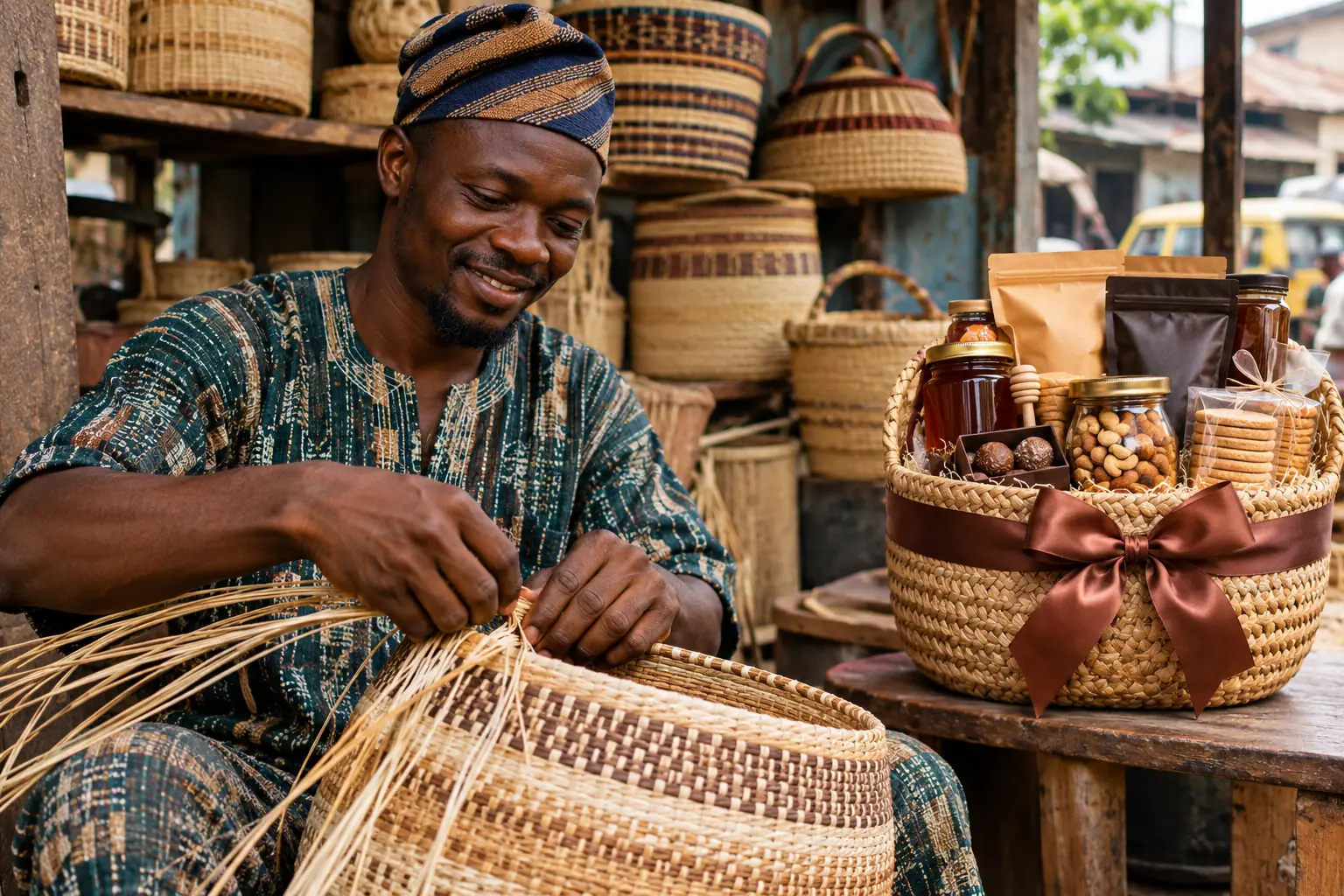
The handwoven baskets Nigeria is known for rely on two plant materials: cane, the hard stem of climbing palms, and raffia, the soft fibre from raffia palm leaves. Cane is stiff, so it gives firm walls, sharp rims and rigid handles. Raffia is supple, so it bends into soft curves and wraps joins. Many baskets combine both.
What are cane and raffia in Nigerian basket weaving?
Cane in basketry usually means rattan: the long, solid stems of climbing palms that grow in humid forest. The stem has a glossy, hard outer skin and a softer, pithy core. Names vary between workshops and markets, so a seller's "cane" may be the whole round stem, a thin core strand or a flat peeled strip.
Raffia comes from the raffia palm, which grows in wet and swampy ground in parts of southern Nigeria. Weavers use the thin outer skin of young leaflets. It dries to a pale straw colour and can be left natural or dyed.
Both are grasses or palms at heart, not wood. They are fibrous, flexible when damp and brittle when bone dry, and that explains most of what follows.
How are cane and raffia prepared to make them workable?
Neither material goes straight from palm to basket. Both need cutting, cleaning, drying and softening.
Preparing cane
- Cut and clean. Stems are cut to length and stripped of leaf sheaths and thorns.
- Dry. Stems are dried so they will not shrink or rot inside a finished basket.
- Split or peel. The hard skin is peeled off in long strips for strong binding, and the core is cut into round strands for spokes and frames.
- Dampen before weaving. Dry cane cracks when bent, so weavers soak or dampen it until it flexes.
Preparing raffia
- Strip. Young leaflets are pulled so the thin outer skin comes away in ribbons.
- Sun-dry. The ribbons are dried and sorted by length and quality.
- Dye or leave natural. Colour is optional.
- Twist, plait or leave flat. Raffia can be worked as flat ribbons, twisted into cord or plaited into braids. A light dampening keeps it from splitting.
How do cane and raffia change a basket's shape and firmness?
Stiffness decides what a weaver can build. Cane resists bending, so it holds a shape on its own. Raffia gives way, so it needs a frame, a core or tight stitching to keep form. This table sums up the difference between cane and raffia baskets.
| Feature | Cane | Raffia |
|---|---|---|
| Feel | Firm, smooth, slightly glossy | Soft, matte, light |
| Typical shapes | Structured: round, oval and rectangular with upright walls | Softer: slouchy totes, bowls, pouches |
| Holds shape unsupported? | Yes | Usually needs a core or tight weave |
| Rim | Crisp, rounded or flat edge | Soft edge, often bound or wrapped |
| Handles | Rigid hoops or bent loops | Flexible plaited or twisted straps |
| Main weakness | Cracks if it dries out or is forced | Frays at edges and sags under heavy loads |
A firm cane basket suits a gift hamper because the walls stay upright when it is full. A raffia basket suits something light that you carry often. Kenya's makers face the same trade-offs with sisal and seagrass, which we cover in how Kenya's sisal and seagrass baskets are woven.
What do weavers use for the body, rim and handles?
Weavers choose each part for the job it does.
- Body. In cane basket weaving in Nigeria, a typical build starts with stiff spokes (stakes) radiating from the base, and flexible strips are woven in and out between them. Raffia bodies are more often coiled around a core or plaited flat, then stitched together.
- Rim. The rim takes the most knocks and holds the walls in shape. Makers often finish it with a thicker cane ring, bound with a thinner strip or raffia so the ends of the spokes are tucked away and cannot snag.
- Handles. A cane handle is a thick strand bent into a hoop and anchored deep in the weave, so it can carry weight. Weavers often wrap it in raffia for grip and a softer feel. Raffia-only handles are plaited and are best for light loads.
This is why Nigerian raffia baskets often show up as soft totes and why cane is used for lidded and structured forms. Hybrids with a cane frame and raffia trim use each material where it is strongest.
Handwoven baskets from Nigeria: what to check before you buy
A good basket looks tidy from the inside as well as the outside. Run through this checklist:
- Even weave. Gaps and loose strands near the base suggest weak spots.
- Rim finish. No sharp ends should poke out, and the binding should sit tight.
- Handle anchoring. Tug gently on the handle. It should be woven into the body, not just tied on.
- Flat base. Place it on a table. Rocking means uneven weaving.
- Smell and feel. Musty or damp-smelling fibre may have been stored badly.
- Labelling. If origin matters to you, read what "made in Nigeria" means on gift labels.
Baskets also double as packaging. WarmBow's The Golden Hour (₦519,186) comes in a large woven cane basket with a champagne ribbon and a printed card carrying your note. That is a premium price. Lagos shops list corporate hampers from roughly ₦19,000 up, and a cheaper hamper suits many budgets. If the basket matters to you, you can see the WarmBow hampers and decide whether the step up is worth it.
How should cane and raffia baskets be stored to limit moisture damage?
Moisture is the main enemy of both materials. Damp fibre can go mouldy, and cane that dries out too fast can crack. In Lagos, where the air is humid for much of the year, storage matters.
- Keep it dry. Store the basket in a dry room, off the floor and away from bathroom or kitchen steam.
- Allow air. Do not seal it in plastic. Trapped moisture causes mildew. A cotton pillowcase or a loose cloth cover keeps dust off while letting air through.
- Avoid direct sun and heat. Strong sun fades raffia and dries cane until it turns brittle.
- Support the shape. Stuff a raffia basket loosely with clean paper so it does not slump, and do not stack heavy items on top.
- Never store it wet. If it gets damp, reshape it and dry it in a shaded, airy spot before putting it away.
- Dust gently. Use a soft dry brush or cloth. Skip soaking and harsh cleaners.
Those steps also show how to care for a raffia basket day to day: keep it dry, keep it out of the sun and let it breathe. If you want to keep a hamper basket after the gift is gone, read can you reuse a woven hamper basket. To dress one for a present, see how to wrap a hamper neatly.
Frequently asked questions
Is cane the same as rattan?
In basket weaving, cane usually means rattan, the stem of a climbing palm. Some sellers use the word more loosely, so ask what material a basket is made from if it matters.
Which is stronger, cane or raffia?
Cane is stiffer and carries weight better, so it suits structured baskets, rims and handles. Raffia is more flexible and lighter, so it suits soft shapes and wrapping. Strength depends on the weave as well as the material.
Can I wash a raffia basket?
Avoid soaking it. Brush off dust with a dry soft brush and wipe marks with a barely damp cloth. Dry it fully in a shaded, airy spot afterwards.
Why do some baskets have raffia wrapped around a cane handle?
The cane gives the handle its strength and the raffia covers it for grip and comfort. The wrap also hides the joins where the handle is anchored.