One employee gift or a shortlist staff can choose from?

For a company-wide gift for employees, one standard gift works best when you want fairness, speed and a shared moment. A short menu of three equal-value choices works better when your team is varied in age, diet, faith or household. Either way, keep the value identical, decide the default early, and keep individual choices private.
When does one standard gift work better than a shortlist?
One standard gift works better when speed, simplicity and a shared experience matter more than personal fit. In practice that means these situations:
- Large or spread-out teams. Every extra choice adds admin: a form, reminders, chasing and a more complicated order.
- A tight deadline. If the gift needs to land before the Jamhuri Day long weekend on 12 December or before Christmas on 25 December, you have no time for a polling round.
- A symbolic gesture. When the point is "everyone got the same thing from the company", identical gifts make the message clear. Nobody wonders whether their option was the better one.
- A broadly safe gift. Coffee, tea, chocolate and honey suit most Nairobi offices, so the risk of a poor match is low.
If your main worry is fairness between roles, our guide on one shared staff gift or a gift for every employee covers that separate decision.
Which gift for employees is better: one item or a menu?
Neither wins everywhere. The same gift for all employees is cheaper to run. A menu respects difference but costs HR time. Compare them side by side:
| Factor | One standard gift | Menu of 3 equal-value choices |
|---|---|---|
| HR time | Low | Medium: form, reminders, tallying |
| Fit for each person | Good for most, poor for a few | Better, especially for dietary or faith needs |
| Perceived fairness | Very high | High, if values are truly equal |
| Order complexity | One item, one quantity | Several quantities to reconcile |
| Risk of complaints | A few "not for me" comments | Fewer, but "why was my choice slower?" is possible |
| Best for | Big teams, tight timelines | Mixed teams, smaller groups, flexible timelines |
A staff gift choice in Kenya often comes down to team size. Under about 30 people, a menu is manageable by one HR person. Above 100, a menu needs a clear owner and a hard deadline, or it stalls.
How many choices are enough without making selection a chore?
Three choices is enough for most teams. Four is the practical ceiling. With two, people feel they are choosing between "the gift" and "the alternative". With five or more, people start comparing and deferring, and your response rate drops.
Make the three options different in kind rather than slightly different versions of one thing:
- A food-and-drink hamper. Something like coffee, tea, chocolate and honey.
- A non-food option. A home or desk item at the same cost to you.
- A flexible option. For example an experience, if your budget and tax adviser agree. Our guide to employee gift ideas for staff who prefer experiences has options.
Equal value means equal cost to the company, not equal retail price. State the budget internally so nobody quietly lets a "cheaper" option win.
A caution on cash. A cash alternative is taxable as employment income in Kenya, while non-cash gifts are not taxed up to a limit. Keep every menu option non-cash.
How can HR collect preferences without publishing individual choices?
HR can keep choices private by owning the collection channel and sharing only totals. The mistakes to avoid are reply-all emails, WhatsApp group polls and shared spreadsheets, all of which show who picked what.
Follow these steps:
- Use a private form. A form where only HR can see responses works well. Do not use an open poll in a staff group.
- Collect only what you need. Name, option chosen, and any allergy or dietary note. Add a delivery address only if you will place the order yourself.
- Set a short deadline. Five working days is plenty. Send one reminder halfway.
- Share totals only. Tell managers "12 chose A, 9 chose B, 4 chose C", not who picked what.
- Limit what the supplier sees. The vendor needs a recipient's name and the item, nothing about why.
- Delete responses after delivery. Keep the order record, not the preference trail.
Dietary and religious needs deserve extra care. Nobody should have to explain in public why they chose a non-food option.
What should happen when someone does not make a selection?
Decide a default before you open the form, and tell everyone what it is. The default should be the standard option from your menu, so that missing a deadline never means missing out.
A simple rule works well:
- Put the default in the invitation: "If we don't hear from you by Friday, you will receive Option A."
- Send one reminder, then apply the default without a chaser.
- Make the default something nearly everyone can accept. Where HR already knows of an allergy, assign a safe option rather than the default.
- Never leave a person without a gift. A missed form is a process failure, not a staff failure.
Staff on leave, in the field or on job-share arrangements are the most likely to miss a form. Read Christmas staff gifts for Kenyan employees who job-share if that applies to you.
What does it cost, and where does WarmBow fit?
Budget first, then format. For example, 40 staff at KES 15,000 each comes to KES 600,000. Entry corporate hampers in Nairobi start far lower, often around KES 4,000 to KES 5,000, so cheaper choices exist. See gifts for employees under KES 5,000 if that suits your budget better.
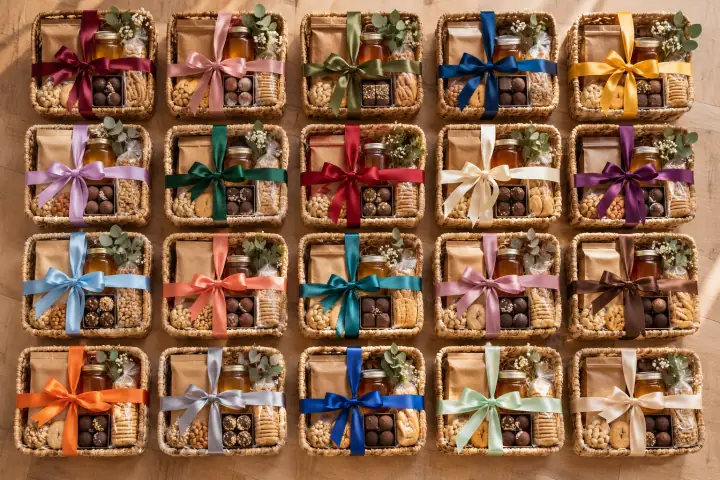
WarmBow hampers are a premium option. The Little Joy at KES 15,000 holds Kericho Gold infusions, Java House ground coffee, Ferrero Rocher, a 70% dark chocolate bar, two kinds of macadamias, cheddar crackers and Kenyan comb honey, in a sisal basket with a satin ribbon and a card carrying your note. It contains nuts, so someone with a nut allergy needs an alternative.
WarmBow's four hampers are priced differently (KES 15,000, 25,000, 50,000 and 75,000), so it does not offer a choice between hampers at the same value. In a menu, The Little Joy would be one option alongside alternatives you source at the same budget. You can mix hampers in one order, and recipients can confirm their own delivery address privately after payment. Delivery dates and any charges are confirmed before you pay.
On tax, non-cash benefits are tax-free for an employee while their total stays at or below KES 60,000 a year, but confirm with your tax adviser. Our guide on whether staff gifts are taxable in Kenya explains the detail.
Frequently asked questions
Is it fair to give different gifts if the value is the same?
Yes, if the cost to the company is truly equal and the budget is stated internally. Fairness means equal value and equal access to choose, not identical items.
Should managers see which option their team chose?
No. Give managers totals only. Individual choices can reveal diet, faith or personal circumstances, and HR should keep them private.
When is a menu not worth the effort?
A menu is rarely worth it for very large teams on a tight deadline, or when the gift is a small token. One safe standard gift is quicker and still appreciated.
Can a menu include a cash option?
It is best not to. Cash gifts are taxable as employment income in Kenya, while non-cash gifts are tax-free up to KES 60,000 a year in total. Confirm your own position with a tax adviser.