Is it cheaper to make or buy a hamper in Kenya?

Making a hamper is cheaper only when your full DIY total, including basket, packaging, transport, leftovers and your time, comes in below a ready-made hamper with equivalent contents. For any comparison of a DIY hamper with buying one in Kenya, the fair method is a worksheet that prices both sides line by line.
Which costs should go into a DIY hamper budget?
A DIY hamper budget should include every cost of getting the finished gift into the recipient's hands, not just the items inside. People usually count the food and forget the rest, which makes making look cheaper than it is.
Put these lines on your worksheet:
- Contents: every product, at the size you would actually give.
- Basket or box: the container itself. Our guide on how to choose a woven gift basket in Kenya shows what to look for in one.
- Dressing: ribbon, filler, tissue, a gift tag and a card.
- Transport to buy: matatu, fuel, parking or ride-hailing between shops.
- Delivery to the recipient: a boda, courier or your own trip.
- Spoilage or substitutions: items that were out of stock or that you had to replace.
- Your time: shopping and assembly hours, valued honestly (more below).
How do leftover supplies affect the comparison?
Leftovers lower your DIY total only if you will genuinely use them. A roll of ribbon or a large jar of honey is a real cost today, and a credit later only if it gets used.
Use this rule on the worksheet:
- List every supply you bought in a larger quantity than one hamper needs.
- For each one, write the portion you will definitely use in the next few months, within its best-before date for food.
- Enter that portion's value as a leftover credit and subtract it from the DIY total.
- Credit nothing for items you would not buy again or that will sit in a cupboard.
Making several hampers changes the sums. Ribbon, filler and tags bought once spread across all of them, so the leftover credit shrinks. For a single gift, expect most packaging leftovers to be waste.
How can shopping and assembly time change what feels cheaper?
Time makes DIY feel cheaper at the till and dearer by the end of the weekend. Cash leaves your wallet in one place, while the hours disappear across several shops.
Track three kinds of time:
- Shopping time: hunting for eight to ten different products across Nairobi often means several stops, and some may not stock what you want.
- Assembly time: arranging, wrapping, writing the card and photographing it.
- Delivery time: getting the hamper to the recipient, or arranging for someone to do so.
Assign an hourly value. For a personal gift, it might be zero if you enjoy the project. For a company, it is your team's cost, which is why corporate buyers often find ready-made cheaper in practice. Our piece on corporate gifts in Kenya and when to buy a ready-made gift covers that side.
DIY hamper vs buying a hamper in Kenya: the comparison worksheet
Copy this table and fill in both columns with real quotes or receipts. Leave a line blank only if it truly costs you nothing.
| Cost line | DIY (KES) | Ready-made (KES) |
|---|---|---|
| Contents | KES ____ | Included |
| Basket or box | KES ____ | Included |
| Ribbon, filler, card | KES ____ | Included |
| Travel to shops | KES ____ | KES 0 |
| Delivery to recipient | KES ____ | KES ____ (confirm) |
| Spoilage and substitutions | KES ____ | KES 0 |
| Time (hours × hourly value) | KES ____ | KES 0 |
| Less: leftover credit | − KES ____ | KES 0 |
| Total | KES ____ | KES ____ |
The ready-made column is often a single price, plus any delivery charge confirmed before you pay.
How do you compare your DIY total against a ready-made hamper of equivalent contents?
Compare like with like by copying a ready-made hamper's contents list into your DIY column, matching products, weights and packaging. Then price that exact list yourself.
- Pick a ready-made hamper whose contents list is published in full.
- Write each item with its brand and weight on your worksheet. A 250 g honey and a 125 g pot of macadamias are different lines.
- Match the extras: basket type, ribbon, tag and card.
- Price every line from the shelf or a quote, not from memory.
- Complete the worksheet above and compare the two totals.
If your list swaps in cheaper items, you are comparing different gifts, so note the downgrade rather than calling it a saving. For a sense of the market, see how much a gift hamper costs in Kenya.
Where do ready-made prices start, and where does WarmBow sit?
In online Nairobi listings, ready-made hampers run from roughly KES 2,000 up to just over KES 50,000. Many entry corporate hampers sit around KES 4,000 to 5,000. If your budget is at that end, a cheaper hamper may beat both DIY and premium options.
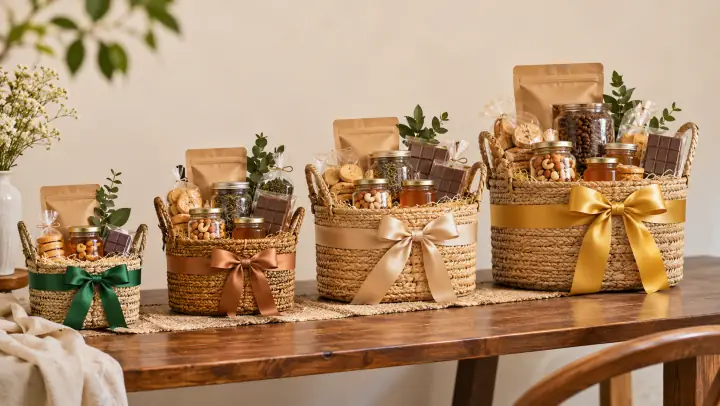
WarmBow is a premium option. Its four hampers are fixed-price:
- The Little Joy: KES 15,000
- The Slow Morning: KES 25,000
- The Golden Hour: KES 50,000
- The Grand Gesture: KES 75,000
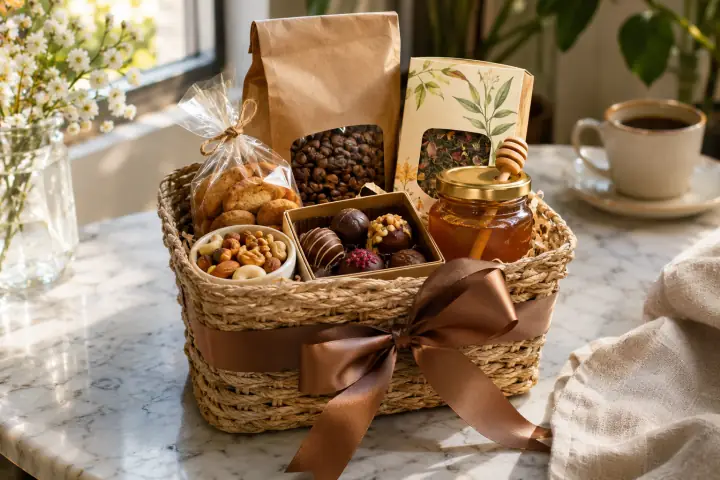
Each comes in a handwoven sisal and seagrass basket with a satin ribbon, swing tag and printed greeting card carrying your personal note, so those lines are already covered. You can browse the hampers and match one to your list.
Delivery covers Nairobi only for now, and any delivery charge is confirmed before payment.
When does making win, and when does buying win?
Making tends to win when:
- You already own the basket, ribbon and filler.
- You are giving one gift to someone nearby, so delivery costs little.
- The value is in a personal touch, such as a homemade jam or a favourite local snack.
- You enjoy the shopping and assembly.
Buying tends to win when:
- You are gifting several people, or clients, and need consistency.
- Recipients are spread across Nairobi, so delivery is a real cost.
- Time is short or your hourly value is high.
- You want one invoice for records. For client gifts, KRA deductions need valid eTIMS invoices, and a DIY hamper bought across many small shops can leave you with a patchy paper trail. Confirm treatment with your tax adviser.
Frequently asked questions
Is a homemade hamper always cheaper than a bought one in Kenya?
No. A homemade hamper is cheaper only if the full DIY total, including basket, packaging, transport, delivery and time, is below the ready-made price for equivalent contents. For a single gift, buying often costs about the same once those extras are counted.
How should I set a homemade hamper budget in Kenya?
Start from the ready-made hamper you would otherwise buy and treat its price as your ceiling. Then work through the worksheet. If your DIY total, after leftover credit, stays under that ceiling for the same contents, making is the cheaper route.
Should I count my own time when making a hamper?
Count it if the time has a cost, such as a staff member's hours or a trip you would not otherwise make. For a personal gift you enjoy making, you can set the hourly value to zero, but say so on the worksheet so the comparison stays honest.
Can I treat leftover ribbon and filler as savings?
Only the part you will actually use. If you will use half the ribbon on future gifts, credit half its cost. If the rest will go unused, treat the full purchase as part of this hamper's cost.