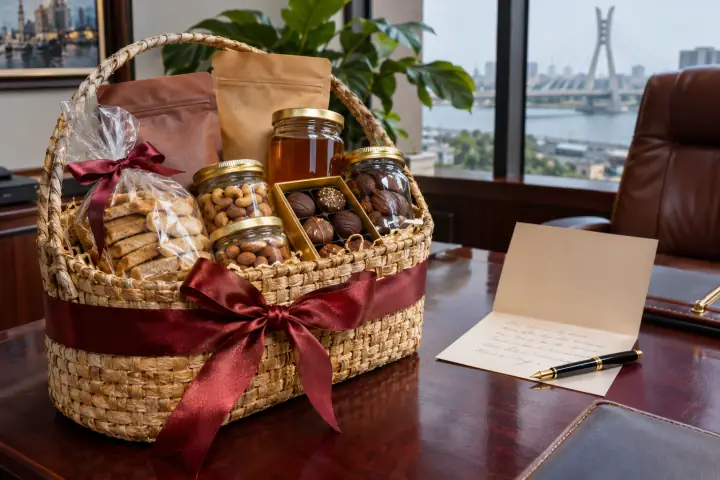
How to offer Nigerian clients a choice of corporate gift

The simplest approach to corporate gift choice for clients that Nigerian businesses can run is a short preference step before you buy: send two or three options of similar value, ask only for the details you need, and include an easy way to say no. It takes little effort per client and avoids gifts that are refused, wasted or awkward to receive.
When is asking for a preference more considerate than surprising the recipient?
Asking is more considerate when the gift could create a problem for the client. That means a company gift policy, a dietary or religious restriction, an unknown address, or a relationship that is still new.
Surprise still works well in other cases. If you have worked with a client for years, know their taste and have their office address, a surprise feels personal. If you are unsure, ask.
Four situations where a preference step is the better choice:
- Regulated or policy-bound clients. Banks, multinationals and public bodies often limit what staff can accept. A client who must decline a gift is better off declining a form than a delivery.
- Dietary and religious needs. Alcohol, pork or sweets in quantity may not suit the person. A food hamper sent without checking can go to waste.
- Remote or hybrid clients. If you do not know whether they sit in an office or work from home in Lagos, a wrong address wastes the gift.
- Senior contacts with assistants. The gift may be opened by someone else, so a stated preference helps it reach the right person.
For clients you know well, our guide on how to choose corporate gifts for clients covers when a surprise is the safer bet.
Corporate gift choice for clients in Nigeria: how to set up the preference step
Keep the step short enough that a busy client answers in under a minute. A short email or WhatsApp message with a link to a three-field form is enough.
- Decide the budget per client first. Set one value band before you write to anyone, so every option sits inside it.
- Shortlist two or three options. Include at least one that is not food, plus the choice to decline.
- Write a warm, plain message. Say who you are, why you are writing and that the client may say no without explanation.
- Send a short preference form. Use a form, a reply-with-a-letter message or a WhatsApp poll. Anything that takes one tap is better than a long email chain.
- Set a reply window. Tell clients when you need an answer so your order is not held up. Pick a date that suits your own timeline.
- Order against the replies. Once answers are in, place the order, personalising each gift with the client's name and your note.
Example wording: "We would like to send you a small thank-you for this year. Please pick A, B or C below, or tell us you would rather we did not. No reply needed if you prefer no gift."
How many choices should you offer, and should they be similar in value?
Offer two or three choices of broadly similar value. One option is not a choice, and four or more makes the client work. Similar value matters because a visibly cheaper or dearer option makes the client feel ranked, and it makes your budget unpredictable.
A workable set within one budget band:
| Option | What it is | Why include it |
|---|---|---|
| A | A food and drink hamper | Easy to share with a team and widely liked |
| B | A non-food gift | Suits clients who avoid sweets, caffeine or alcohol |
| C | A donation in the client's name, if you already give to causes | Works for clients with strict gift rules |
| D | Decline, with a thank-you note only | Keeps the offer comfortable to refuse |
Not every set needs all four rows. Two gifts plus a decline is often enough. For ideas on option B, see non-food corporate gifts for clients in Nigeria.
What is the minimum information you need from the client?
You need very little. Ask for the following and nothing more:
- Their choice (A, B, C or decline).
- Delivery detail: an address in Lagos, or permission for the recipient to confirm it themselves.
- Contact route: a working email address and an international WhatsApp number.
- Any restriction, as an optional line for allergies, religious needs or company policy.
You already hold the name and company. Do not ask for birthdays, job titles or personal preferences that will not change what you send.
If you would rather not collect addresses at all, WarmBow can contact each recipient by email and WhatsApp after payment so they confirm their own address privately. That fits clients who would rather not hand over a home address in a form. Recipients never pay and never see the price.
How should you handle a decline or no response?
Treat a decline as a normal, successful answer. Reply with a short thank-you, record it, and do not push an alternative. A client who says no and is thanked graciously remembers the courtesy.
For no response, agree your rule before you send:
- Send one reminder a few working days after the first message, and keep it light.
- If there is still no reply, fall back to your pre-agreed default. Either send a card with a personal note and no gift, or send the safest option from your list.
- For policy-bound clients, the card is the safer default. A gift that must be returned is worse than none.
- Log the outcome in your client records so next year's list starts informed. Our guide on how to pick a Christmas gift for a named client shows how to keep those notes useful.
What about cost and tax records?
Be honest about budget. Lagos gift shops list entry and mid-range corporate hampers from roughly ₦19,000 to ₦135,000, and cheaper options suit many client lists. WarmBow hampers sit in the premium band. The indicative naira prices are:
- The Little Joy: ₦155,756
- The Slow Morning: ₦259,593
- The Golden Hour: ₦519,186
- The Grand Gesture: ₦778,779
Pick the one that matches your client's seniority and your budget, not the most expensive.
Because the buyer chooses any mix of hampers in one order, different clients can receive different hampers. Delivery dates and any delivery charges are confirmed before payment, and delivery currently covers Lagos only among Nigerian cities.
On tax, the Nigeria Tax Act 2025 (section 20) allows expenses wholly and exclusively incurred in producing income. A preference form helps here because it records a clear business purpose. Keep the replies, invoices and your gift list. Our guide on whether corporate gifts are tax deductible in Nigeria goes further, and you should confirm your own position with a tax adviser.
Frequently asked questions
When should a company ask a client's preference instead of sending a surprise?
Ask when the client may have a gift policy, dietary or religious restrictions, or an address you do not know, or when the relationship is new. Surprise gifts suit long-standing clients whose taste and address you already know.
How many gift options should I offer a client?
Offer two or three options of similar value, plus an easy way to decline. One option is not a real choice, and more than three slows the client down. Keeping the values close avoids making anyone feel ranked.
What information do I need to collect for a client gift choice?
Collect their choice, a Lagos delivery address (or permission to let them confirm it), an email address and an international WhatsApp number. Add an optional line for restrictions. You already hold their name and company.
What should I do if a client declines or does not reply?
Thank a declining client briefly and record their answer. If there is no reply, send one reminder, then use a default you set in advance, usually a personal card with no gift.
Can I offer a choice of gift to clients outside Lagos?
WarmBow does not yet cover cities outside Lagos in Nigeria. For clients elsewhere, a card or a gift arranged through another route may be the practical choice for now.