Does a flat-packed hamper arrive assembled?

The meaning of a flat-packed hamper is simple: the packaging arrives folded or taken apart, not built. So a flat-packed hamper does not arrive assembled. The term usually describes the container, such as a box or tray, not the gift inside. Check the listing for assembly wording before you buy.
What is the meaning of a flat-packed hamper?
"Flat-packed" describes the condition of the packaging: it is supplied folded, collapsed or in separate pieces so it takes up little space in transit. It is the same idea as flat-pack furniture. Someone has to put it together before it can hold anything.
That tells you three things:
- The container is not in its final shape when it reaches you.
- Some assembly, even if only folding and tucking, is probably your job.
- Nothing about the phrase promises that the gift itself is included, packed or arranged.
The reverse is the "assembled hamper" meaning. An assembled hamper has been built, filled and finished by the seller, so it arrives ready to hand over.
Can "flat-packed" describe the container without the contents?
Yes. In most listings the term belongs to the container alone. A seller can flat-pack a cardboard gift box, a tray, a divider insert or a ribbon-and-tag set, and the phrase says nothing about whether tea, coffee or chocolate comes with it.
There are three common readings, and they are easy to confuse:
- An empty container, flat-packed. You buy the box or basket and fill it yourself.
- Separate packaging components. The box, filler, ribbon and card arrive as individual parts for you to combine.
- The whole gift, packed flat. This is rare, because a full hamper with jars, tins and mugs cannot be folded flat without damaging the contents.
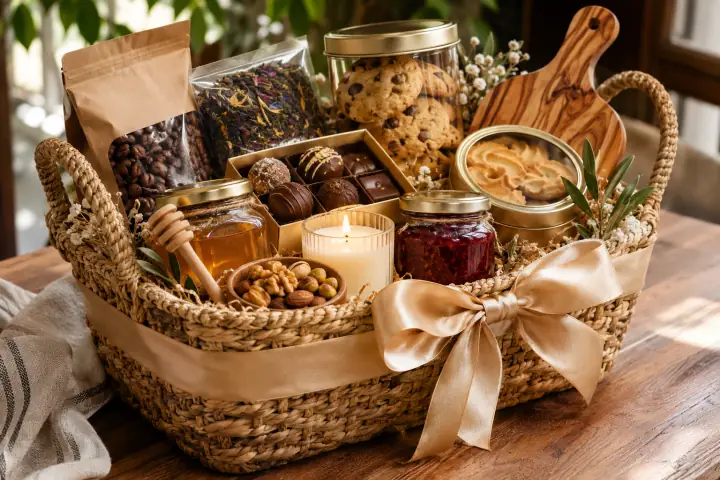
If a listing says "flat-packed" next to a photo of a full, styled hamper, treat the photo as an illustration of the finished result, not of what arrives. For a deeper look at how bundled items are described, see our guide on whether a gift bundle comes packed as one hamper.
Flat-packed basket vs filled hamper: what is the difference?
The comparison below is the quickest way to see what you are actually buying.
| Flat-packed container | Assembled, filled hamper | |
|---|---|---|
| What arrives | Folded or separate packaging parts | A built container with gifts inside |
| Your work | Assemble, source and arrange contents | Add a note, hand it over |
| Contents included | Usually none | Yes, listed item by item |
| Best for | Makers and DIY gifters who like to fill their own | Busy teams and people gifting on a deadline |
| Main risk | Wasted time, or contents that do not fit | Paying for a name rather than the items |
A flat-packed container looks cheaper because you are buying less. By the time you have sourced the contents, a ribbon and a card, the difference often narrows. The sums depend on what you buy, so price your own list before deciding. Our explainer on whether a gift basket is the same as a hamper covers the wider vocabulary.
Which wording means assembly is still required?
Some listings never use the word "flat-packed" and still describe an unbuilt product. Watch for these phrases:
| Wording in the listing | What it usually means |
|---|---|
| "Assembly required" or "some assembly" | You build it |
| "Self-assembly", "DIY" or "kit" | Parts supplied, you put them together |
| "Unassembled", "knock-down", "ships flat" | Packaging is folded or in pieces |
| "Collapsible" or "foldable" | Folds flat, may need opening out |
| "Empty", "basket only", "box only" | No gifts included |
| "Fill your own" | Contents are your responsibility |
| "Contents not included" | Same as above, stated more politely |
By contrast, "ready to gift", "ready to give", "pre-filled" and "assembled" point to a finished hamper. "Gift-ready" alone is vague, so look for a contents list as well. A genuine filled hamper names its items, usually with weights, such as honey (250 g) or ground coffee (375 g).
How can you verify whether a listing shows the packed or assembled version?
Do these checks before paying:
- Read the title and first line. Words like "empty", "box" or "kit" settle it early.
- Find the contents list. No named items, no weights and no brands usually means no gifts inside.
- Compare the photos. Look for a flat, stacked or folded image. A lifestyle shot with ribbon and filled shelves may show a finished example only.
- Check the dimensions. Flat-packed items often list a folded size and an assembled size. Our guide to reading hamper dimensions written as L × W × H explains how to interpret them.
- Look at the weight. A box that weighs a few hundred grams cannot contain jars, tins and mugs.
- Check for packing protection. A finished hamper that ships with items inside needs padding, and our guide shows how to spot crush protection in a packed hamper.
- Ask the seller in writing. Send one question: "Does this arrive assembled and filled, and what exactly is inside?" Keep the reply for your records.
If the listing, photo and weight tell different stories, assume the least generous reading and ask before you pay.
What does flat pack gift packaging look like in Kenya?
Flat pack gift packaging in Kenya is mostly folding cartons, rigid boxes and paper bags that arrive as stacks of flat sheets. They suit businesses that want branded boxes and have staff time to fill them. Handwoven sisal or seagrass baskets are the opposite: they hold their shape, so they come built, not folded.
For Nairobi buyers, public listings run from roughly KES 2,000 up to just over KES 50,000, and many entry corporate hampers sit around KES 4,000–5,000. If you only need a simple, low-cost gift and have time to assemble it, a flat-packed box with your own contents can be a sensible choice.
If you would rather skip the building, WarmBow's hampers are filled gifts in a handwoven basket, tied with a satin ribbon and finished with a swing tag and a printed card carrying your note. WarmBow is a premium option, starting at KES 15,000, and cheaper hampers exist. These are the four to choose from:
- The Little Joy (KES 15,000): a thank-you or a thinking-of-you gift.
- The Slow Morning (KES 25,000): staff appreciation, with coffee, tea, granola and two stoneware mugs.
- The Golden Hour (KES 50,000): milestones and key client relationships.
- The Grand Gesture (KES 75,000): when only your warmest gesture will do.
Frequently asked questions
Does a flat-packed hamper arrive assembled?
No. Flat-packed means the packaging arrives folded or in separate pieces, so you should expect to assemble it. If you want a hamper that arrives built and filled, look for the words "assembled", "pre-filled" or "ready to gift", and confirm with a contents list.
Does flat-packed mean the hamper is empty?
Not always, but often. The term describes the packaging, not the gifts. Many flat-packed listings sell only the container. Check for a named contents list and a realistic weight before assuming anything is inside.
Is a flat-packed basket the same as a filled hamper?
No. A flat-packed basket or box is a container you fill yourself. A filled hamper arrives with the gifts already chosen and arranged. The difference affects your time, your total cost and how ready the gift is on the day.
Can a woven basket be flat-packed?
Rarely. Woven baskets such as sisal, seagrass, cane or raffia hold a fixed shape, so they are usually sold built. Flat-packing is far more common with cardboard boxes, trays and paper packaging.
What should I ask a seller to confirm the hamper is assembled?
Ask: "Does this arrive fully assembled and filled, and what exactly is inside?" Ask for the item list with weights and an assembled photo. Keep the reply, so you have something to point to if the delivery differs from the listing.